

Senior ocularist and practice owner: Handwritten resume, six pages
A 6-page single-column resume from the handwritten set. The median system scores 40.4 F1 on it; LlamaParse Extract Agentic Plus scores best (74.0) and Extend Max Context worst (26.9). It is the hardest of the 20 published resumes.
- Handwritten
- Image only
- Custom sections
- Promotions
- Partial dates
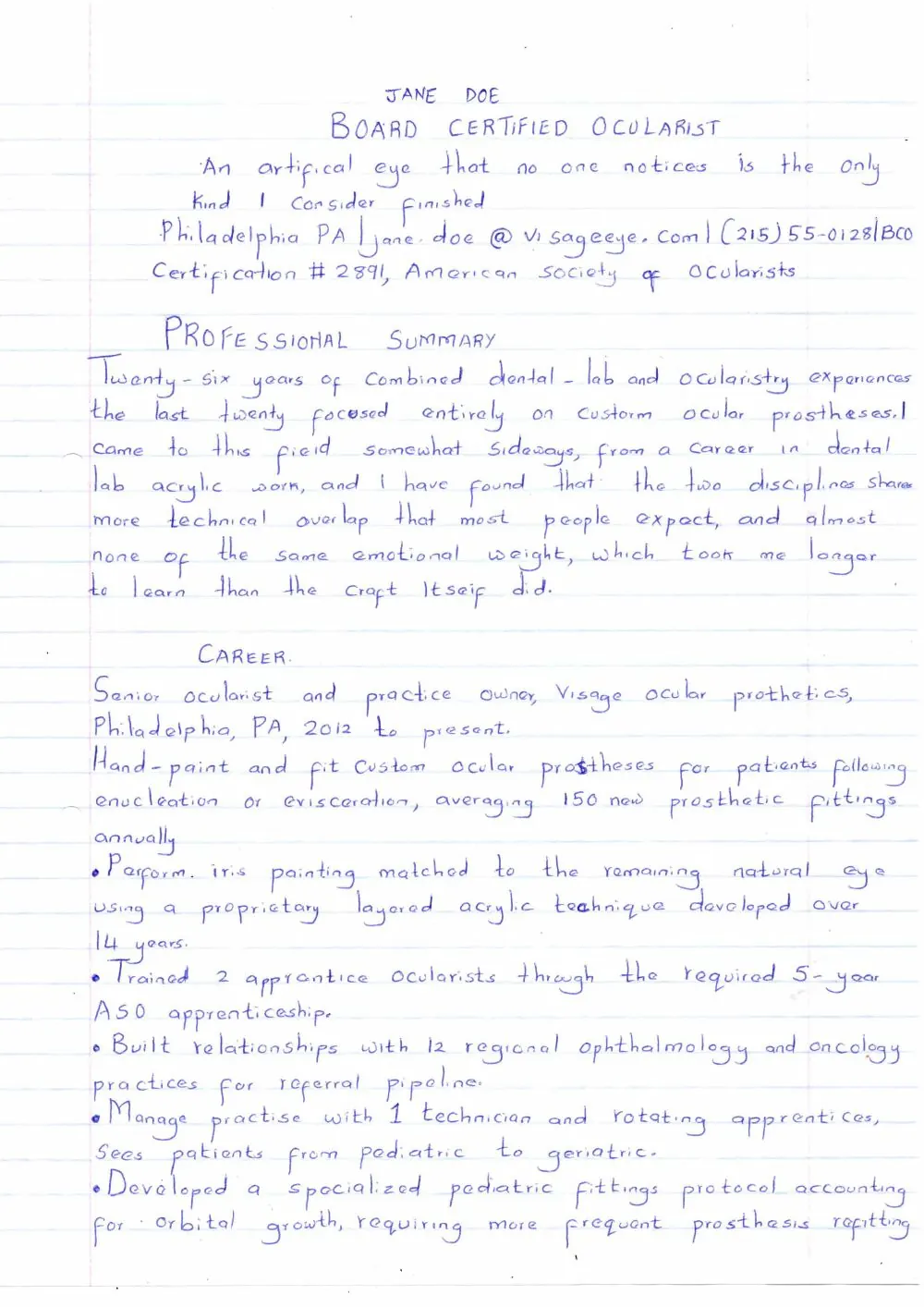
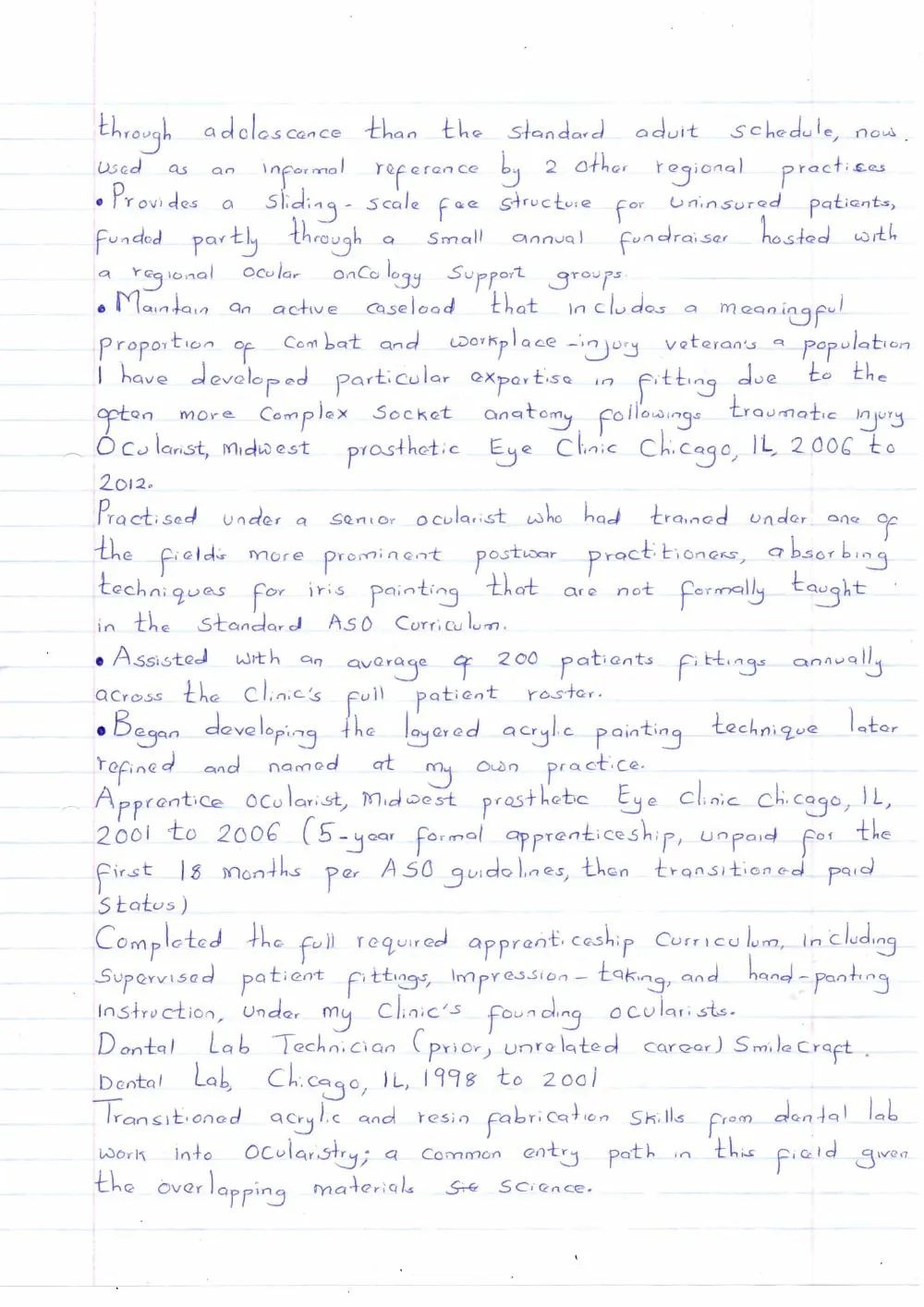
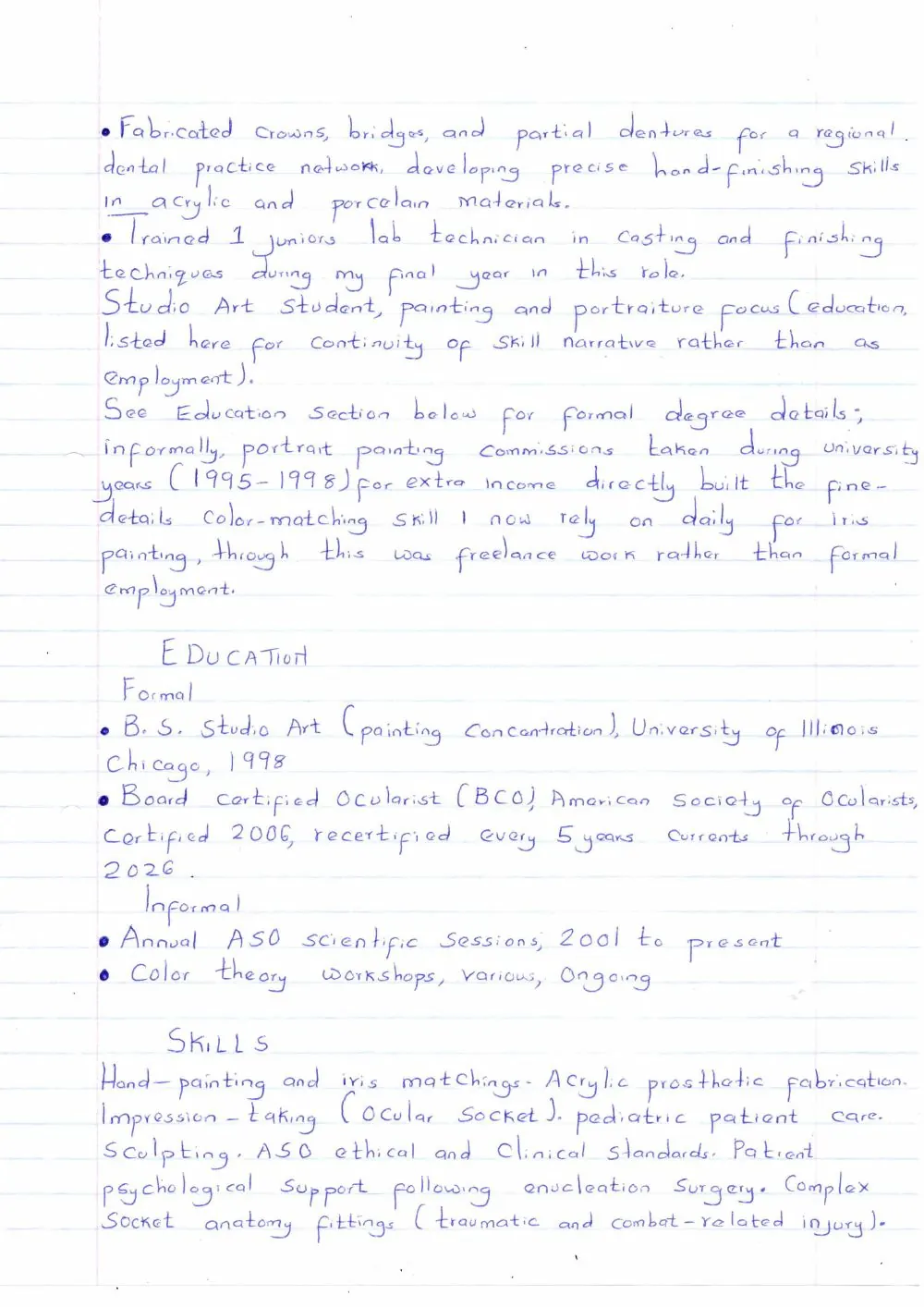
First 3 of 6 pages shown.
Every system on this resume
| Model | F1 here | F1 overall | Gap |
|---|---|---|---|
| LlamaParse Extract Agentic Plus | 74.0 | 87.2 | −13.1 |
| LlamaParse Extract Agentic | 70.4 | 85.5 | −15.1 |
| LlamaParse Extract Cost-Effective | 51.4 | 83.5 | −32.1 |
| Claude Opus 4.8 | 49.7 | 85.5 | −35.8 |
| Reducto Extract | 47.0 | 81.7 | −34.7 |
| Extend Extract | 44.0 | 81.0 | −37.0 |
| Qwen 3.5 9B | 43.7 | 76.0 | −32.3 |
| Qwen 3.8 27B | 41.2 | 83.8 | −42.6 |
| GPT-5.6 | 40.6 | 84.7 | −44.1 |
| Qwen 3.8 Flash | 40.2 | 84.1 | −43.9 |
| Gemini 3.5 Flash | 39.8 | 85.5 | −45.6 |
| Qwen 3.5 35B | 38.5 | 77.9 | −39.4 |
| GPT-5.5 | 37.5 | 83.5 | −46.0 |
| Reducto Deep Extract | 37.4 | 85.6 | −48.2 |
| Gemma 4 26B | 37.0 | 62.8 | −25.8 |
| GLM 5.3 Flash | 36.8 | 59.2 | −22.4 |
| GPT-5.4 Nano | 35.7 | 61.9 | −26.2 |
| Extend Max Context | 26.9 | 84.7 | −57.8 |
Ground truth
What every system is scored against. The person is fictional. Download it (JSON), free to reuse under CC BY 4.0.
Contact
- First name
- Jane
- Last name
- Doe
- jane.doe@visageeye.com
- Phone
- (215)55-0128
- City
- Philadelphia
- State
- PA
- Headline
- BOARD CERTIFIED OCULARIST
Summary
Twenty-six years of combined dental-lab and ocularistry experiences the last twenty focused entirely on custom ocular prostheses. I came to this field somewhat sideways, from a career in dental lab acrylic work, and I have found that the two disciplines share more technical overlap that most people expect, and almost none of the same emotional weight, which took me longer to learn than the craft itself did.
Experience
Senior ocularist and practice owner · Visage ocular prothetics
2012 – present · Philadelphia, PA
Hand-paint and fit custom ocular prostheses for patients following enucleation or evisceration, averaging 150 new prosthetic fittings annually
- Perform iris painting matched to the remaining natural eye using a proprietary layered acrylic technique developed over 14 years.
- Trained 2 apprentice ocularists through the required 5-year ASO apprenticeship.
- Built relationships with 12 regional ophthalmology and oncology practices for referral pipeline.
- Manage practise with 1 technician and rotating apprentices, sees patients from pediatric to geriatric.
- Developed a specialized pediatric fittings protocol accounting for orbital growth, requiring more frequent prosthesis refitting through adolescence than the standard adult schedule, now used as an informal reference by 2 other regional practices
- Provides a sliding-scale fee structure for uninsured patients, funded partly through a small annual fundraiser hosted with a regional ocular oncology support groups.
- Maintain an active caseload that includes a meaningful proportion of combat and workplace-injury veterans, a population I have developed particular expertise in fitting due to the often more complex socket anatomy following traumatic injury.
Ocularist · Midwest Prosthetic Eye Clinic
2006 – 2012 · Chicago, IL
Practised under a senior ocularist who had trained under one of the field's more prominent postwar practitioners, absorbing techniques for iris painting that are not formally taught in the standard ASO curriculum.
- Assisted With an average of 200 patients fittings annually across the clinic's full patient roster.
- Began developing the layered acrylic painting technique later refined and named at my own practice.
Apprentice ocularist · Midwest Prosthetic Eye Clinic
2001 – 2006 · Chicago, IL
5-year formal apprenticeship, unpaid for the first 18 months per ASO guidelines, then transitioned paid status
- Completed the full required apprenticeship Curriculum, including Supervised patient fittings, Impression-taking, and hand-panting Instruction, Under my Clinic's founding ocularists.
Dental Lab Technician (prior, unrelated career) · SmileCraft Dental Lab
1998 – 2001 · Chicago, IL
- Transitioned acrylic and resin fabrication Skills from dental lab work into Ocularistry; a common entry path in this field given the over lapping materials Se Science.
- Fabricated crowns, bridges, and partial dentures for a regional dental practice network, developing precise hand-finishing skills in acrylic and porcelain materials.
- Trained 1 juniors lab technician in casting and finishing techniques during my final year in this role.
Education
B.S. · University of Illinois Chicago
1998 · Chicago · Studio Art (painting concentration)
Skills
Hand-painting and iris matchings, Acrylic prosthetic fabrication, Impression -Eaking. (Ocular Socket), pediatric patient care, Sculpting, ASO ethical and clinical standards, Patient psychological support following enucleation surgery, Complex socket anatomy fittings (traumatic and combat-related injury), Portrait-level color matching and fine detail painting
Certifications
Board certified Ocularist (BCO) · American Society of Ocularists
2006
Awards
regional recognition for pediatric care protocol contribution · American society of ocularists
2019
Custom sections
NOTABLE CASEWORK (ANONYMIZED, DESCRIBED ONLY AT A CATEGORY LEVEL PATIENT PRIVACY)
- Pediatric patients requiring staged prosthesis enlargement through adolescent orbital growth, an ongoing multi-year clinical relationship in several cases. Adult patients with complex socket anatomy following traumatic or combat-related injury, requiring a custom-molded conformer prior to final prosthesis fitting. Long-term geriatric patients whose original prostheses were sometimes decades old, requiring full replacement due to material degradation rather than changes in socket anatomy.
PROFESSIONAL AFFILIATIONS AND SERVICE
- American Society of Ocularists, member since 2001, board certified since 2006. Occasional guest lecturer, a regional school of optometry's ocular anatomy course. Invited annually since 2016 to speak on prosthetic fitting from a non-surgical practitioners perspective.
NOTE
- Candidates was previously a dental lab technician for three years before an unrelated career change into ocularistry, a common entry path in this field given the overlapping acrylic and resin skills between the two trades.
THE FITTING PROCESS, IN DETAIL
- Patients unfamiliar with ocularistry are often surprised at how Involved the fitting process actually is. A first fitting typically involves taking a precise impression of the ocular socket using a technique adapted, more that most patient realize, from dental impression method, followed by wax modeling of the prosthesis shape, and finally the hand-painting stage, where I work directly against the patient's remaining natural eye, layering thin coat of acrylic paints to build up the iris pattern, blood vessel detail, and scleral shading until the two eyes read as a matched pair under normal lighting. A single new prosthesis typically takes 3 to 4 patient visits spread across several weeks and I have never found a way to meaningfully compress this timeline without sacrificing the quality of the final color match.
WORKING WITH PATIENTS
- The technical craft is, honestly, the easier half of this job. Most of my patients arrive at their first appointment still processing a significant recent medical trauma, whether from cancer treatment an accident, or a congenital condition managed since childhood, and a meaningful part of my role is simply being a calm, unhurried presence during a process that can otherwise feel clinical and impersonal at exactly the moment a patient needs the opposite. I ask every new adult patient the same first question, which is not about their eye at all but about what they do for work and what they care about, because it tells me more about how they want their prosthesis to look and read to other people than any technical measurement does.
CONTINUING EDUCATION AND TECHNIQUE REFINEMENT
- I attend the ASO's annual Scientific Sessions every year without exception, not only for the formal continuing education credit but because the informal conversation with other ocularists at these sessions has been, over two decades, a more valuable source of technique refinement than almost any single course. The layered acrylic painting method I now used and have informally taught to my two apprentices was built up gradually over roughly fourteen years of small adjustments, most of them originating from exactly these kinds of hallway conversations rather than from any single formal training source.
REFERENCES
- Available upon request; several supplied directly by referring physician, contact details withheld consistent with the practices patient - privacy norms.
Easier: senior Consultant - package Implementation →All published resumes


